

A domain looks promising. The name is clean, the asking price is reasonable and the seller says it has “been online for ten years.” I open a WHOIS report before I open another SEO tool.
The result rarely gives me a dramatic yes or no. It gives me dates, a registrar, nameservers and a row of status codes that look as if they escaped from a server log. Those details can still expose a bad assumption in a minute.
I use WHOIS as a registration check. It helps me confirm that a domain exists in the registry, see who manages it and understand where it sits in the registration lifecycle. Website history, backlink quality and current DNS need separate checks.
WHOIS now usually means WHOIS plus RDAP
People still say “WHOIS lookup,” even though the underlying system has changed. RDAP, short for Registration Data Access Protocol, became the definitive source for generic top-level domain registration data in January 2025. It returns structured data and handles international characters, access rules and redaction more consistently than the old WHOIS protocol.
The old term survives because everyone recognizes it. Many lookup services now query RDAP, classic WHOIS where it remains available, or both. Karma.Domains does both and merges the clearest public fields into one readable report. That saves me from comparing two raw outputs by hand.
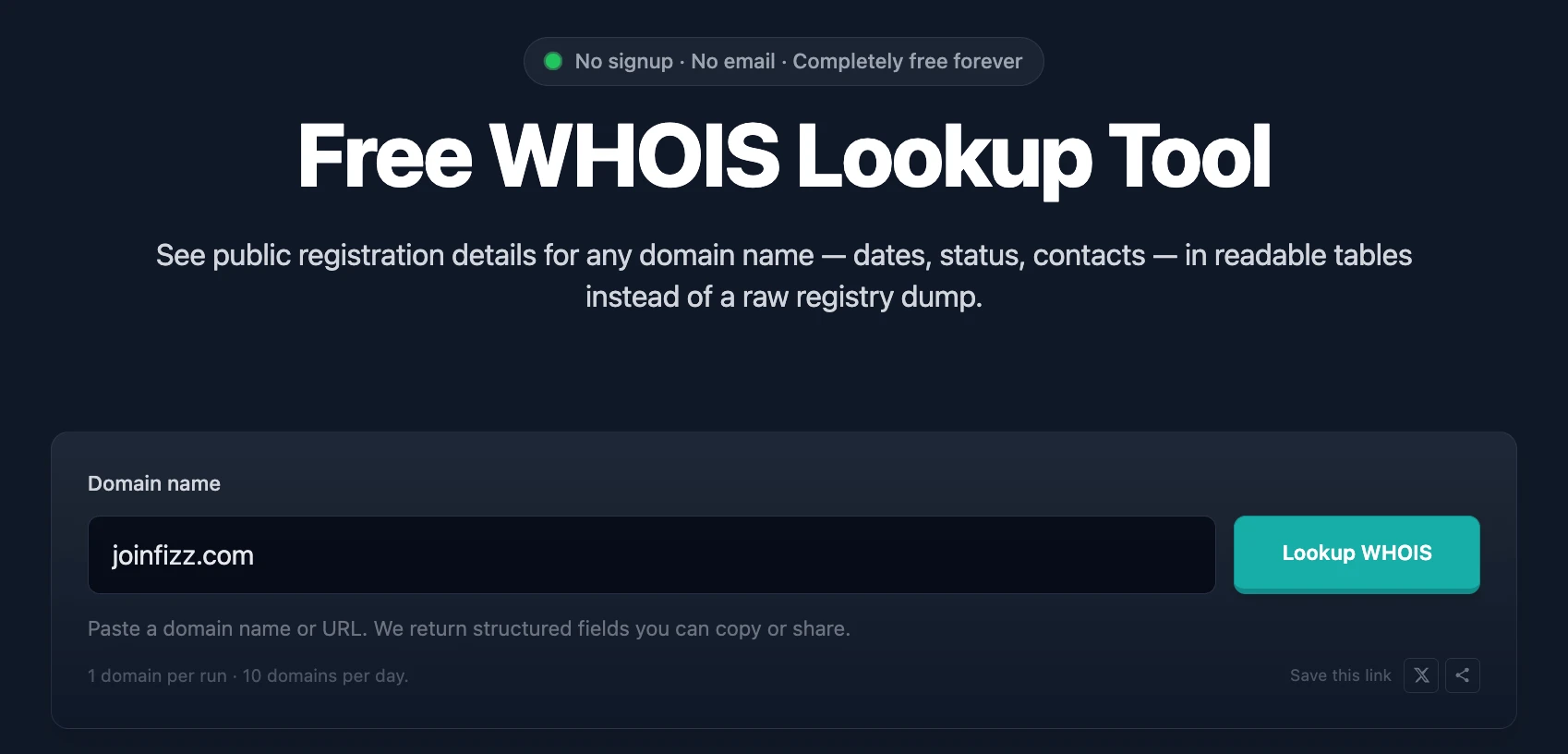
When I want a quick report, I use the free WHOIS lookup tool and start with the Domain, Registrar and Contact sections. The raw record stays useful when a parsed field looks odd or I need to keep the source response for a handoff.
For scheduled portfolio checks, the Karma.Domains Expired Domains API and MCP can return WHOIS and RDAP fields to a script or AI agent and flag records that need a manual review.
The fields I trust, and what they really say
Creation date
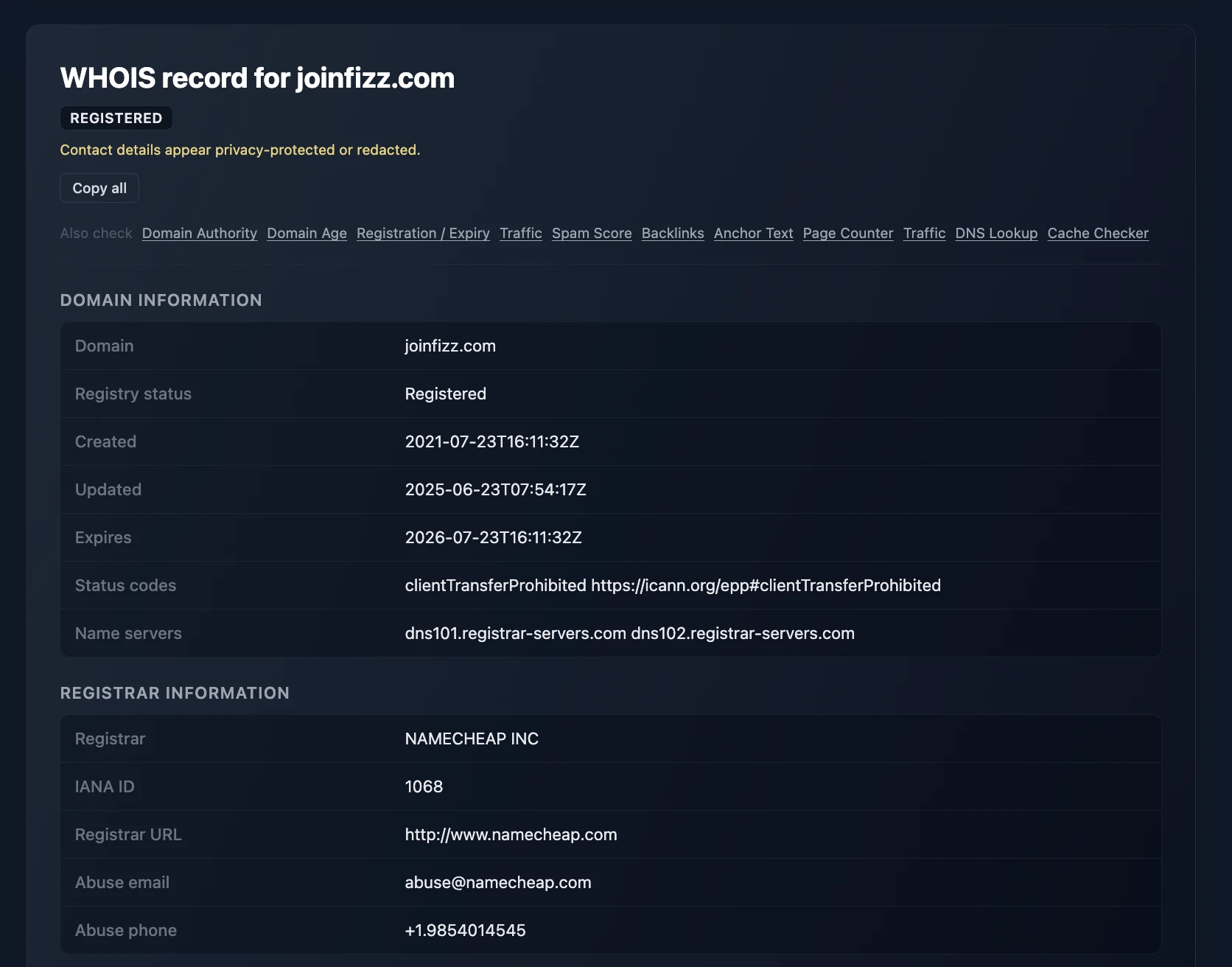
The creation date usually tells me when the current registry object was created. It does not prove that a website has operated continuously since that day. A domain can sit parked for years, expire, change hands or switch topics while the registry date stays the same.
I treat the date as a registration fact. To estimate site age, I check archived pages and historical crawling data. The distinction matters when a seller describes a registered-in-2013 domain as a ten-year-old business.
Updated date
The updated timestamp is easy to overread. A registrar transfer, contact edit, nameserver change, renewal or registry-side update can change it. The field tells me that something in the registration record changed. It rarely tells me what changed.
Expiration date
The expiration date helps with renewal planning and first-pass acquisition research. I never treat it as a guaranteed drop date. Auto-renew grace periods, redemption periods, registrar auctions and registry rules can keep a domain unavailable long after the displayed date.
For a domain I own, the registrar account is the source I act on. For a domain I want to acquire, the WHOIS date tells me when to start watching rather than when to expect an open registration button.
Registrar
The registrar is the company sponsoring the registration. This field helps me find the correct transfer instructions, abuse channel and account recovery path. It also catches a surprisingly common handoff problem: the client thinks the domain lives with the hosting company, while the registration sits in an old employee’s registrar account.
Nameservers
Nameservers show where the domain is delegated for DNS. They can point to a hosting company, a managed DNS provider, a CDN or a marketplace parking service. I use them as a lead, then run a DNS lookup for the live A, AAAA, CNAME, MX and TXT answers.
EPP status codes
Status codes describe restrictions and lifecycle states. They often carry the “client” or “server” prefix, which tells me whether the registrar or registry set the status.
- clientTransferProhibited usually means the domain is locked against transfer.
- clientDeleteProhibited blocks deletion at the registrar level.
- serverHold prevents the registry from publishing the domain in DNS.
- redemptionPeriod means the registration expired and entered a recovery stage.
- pendingDelete means the recovery window has ended and deletion is approaching under the registry’s process.
One code can be routine. A transfer lock is common security hygiene. A hold or redemption status deserves attention because it can affect resolution, ownership work or acquisition timing.
Why the owner is often missing
A modern WHOIS or RDAP result often shows “redacted for privacy,” a proxy organization, an anonymized email address or a contact form. That is expected. Registration-data policy and privacy law limit which personal fields registrars publish.
I do not score a domain down because the registrant’s name is hidden. Privacy redaction says little about the site’s SEO history or legitimacy. Plenty of ordinary businesses and individual owners use it.
If I need to contact the registrant, I look for a relay address or registrar web form. For abuse, trademark or security issues, I use the published registrar abuse contact and document the reason for the request. A public lookup cannot grant access to nonpublic data.
Where WHOIS helps in day-to-day SEO work
Checking an aged-domain claim
If a listing says a domain is old, I compare the WHOIS creation date with the first meaningful archived pages. A 2011 registration with a first real site in 2022 needs a different valuation from a domain that carried the same business for a decade.
Ownership changes may leave indirect clues such as a registrar switch, new nameservers, a new site topic or a gap in archived pages. WHOIS alone cannot prove a sale. Several matching changes give me a reason to inspect the timeline more closely.
Reviewing a domain before purchase
For a live purchase, I confirm the registrar, status, dates and nameservers first. Then I check the live site, DNS, archive history, backlinks and anchor text. The order is practical: registration data confirms which object I am researching, while the other checks tell me what that object has been used for.
This becomes more important with dropped names and auctions. That is where Karma.Domains enters my process: I check expired domains against archived pages and backlink data before I spend money on them. A clean WHOIS report cannot show an old pharma redirect, a scraped-content phase or a backlink profile built around another language.
Preparing a migration or client handoff
Before a migration, I record the registrar, nameservers, expiration date and transfer status. This tiny inventory answers operational questions that an SEO crawl will miss. Who can change delegation? Is the domain locked? Is renewal due during launch week? Does the client control the account?
I also keep registrar access separate from hosting and DNS access in the project notes. One vendor may handle all three, though the permissions and failure modes remain different.
Cleaning up a domain portfolio
An agency can inherit dozens of domains from campaigns, redirects and abandoned microsites. WHOIS helps identify the sponsoring registrar and renewal dates. I pair that with analytics, backlink data and redirect checks before recommending renewal or cancellation.
The registration fee is usually small. The expensive mistake is dropping a domain that still carries branded links, email infrastructure or a redirect users depend on.
Investigating a suspicious domain
For phishing, impersonation or spam research, the registrar, creation date, nameservers and status can help establish a timeline. A very recent registration may support the broader evidence, although age by itself proves nothing.
I save the raw response and timestamp the check because registration data can change. I also capture the page, DNS answers and relevant headers. WHOIS is one piece of evidence rather than the whole case.
A five-minute workflow for beginners
I use the same short sequence for most checks:
- Enter the root domain without a path or tracking parameters.
- Confirm the domain name and TLD in the returned record.
- Read the creation, updated and expiration dates separately.
- Note the registrar, nameservers and every EPP status code.
- Treat redacted contact fields as unavailable public data, not as missing ownership proof.
- Open the raw response if a parsed value conflicts with another source.
- Move to DNS, archived pages and backlink checks when the question concerns the website rather than the registration.
I save a screenshot or copied report when the result affects a purchase, migration or dispute. A live lookup can look different next month after a renewal, transfer or privacy change.
Common mistakes I avoid
Calling the creation date “domain age”
Registration age and website age overlap sometimes. They are separate facts. Archived content is the better source for when a site existed and what it published.
Assuming privacy means suspicious ownership
Privacy protection is routine. I look for behavioral evidence such as copied pages, deceptive redirects, malware warnings or abusive email. A redacted name does not supply that evidence.
Treating the expiration date as an acquisition schedule
Registry lifecycle rules and registrar auctions sit between expiration and public availability. I watch status codes and auction channels instead of circling one WHOIS date on the calendar.
Using WHOIS as a DNS checker
Nameserver rows show delegation. They do not show every live record or how public resolvers currently answer. I use a DNS lookup when the question involves IP addresses, email routing, verification records or a recent infrastructure change.
Using WHOIS as an SEO verdict
A domain can have orderly registration data and a terrible history. It can also have redacted contacts and a clean, stable site. My buying decision comes after I line up registration facts with archive history, backlinks, anchors, live content and DNS.
The line I keep in mind
WHOIS tells me who manages the registration, when registry events occurred and which restrictions are active. It cannot tell me what Google remembers about the site.
So I use the report to verify the domain record and decide the next check. If the question is about past content or link equity, I leave WHOIS open for reference and move on to the evidence that can answer it.
Want to publish a guest post on aamconsultants.org?
Place an order for a guest post or link insertion today.