
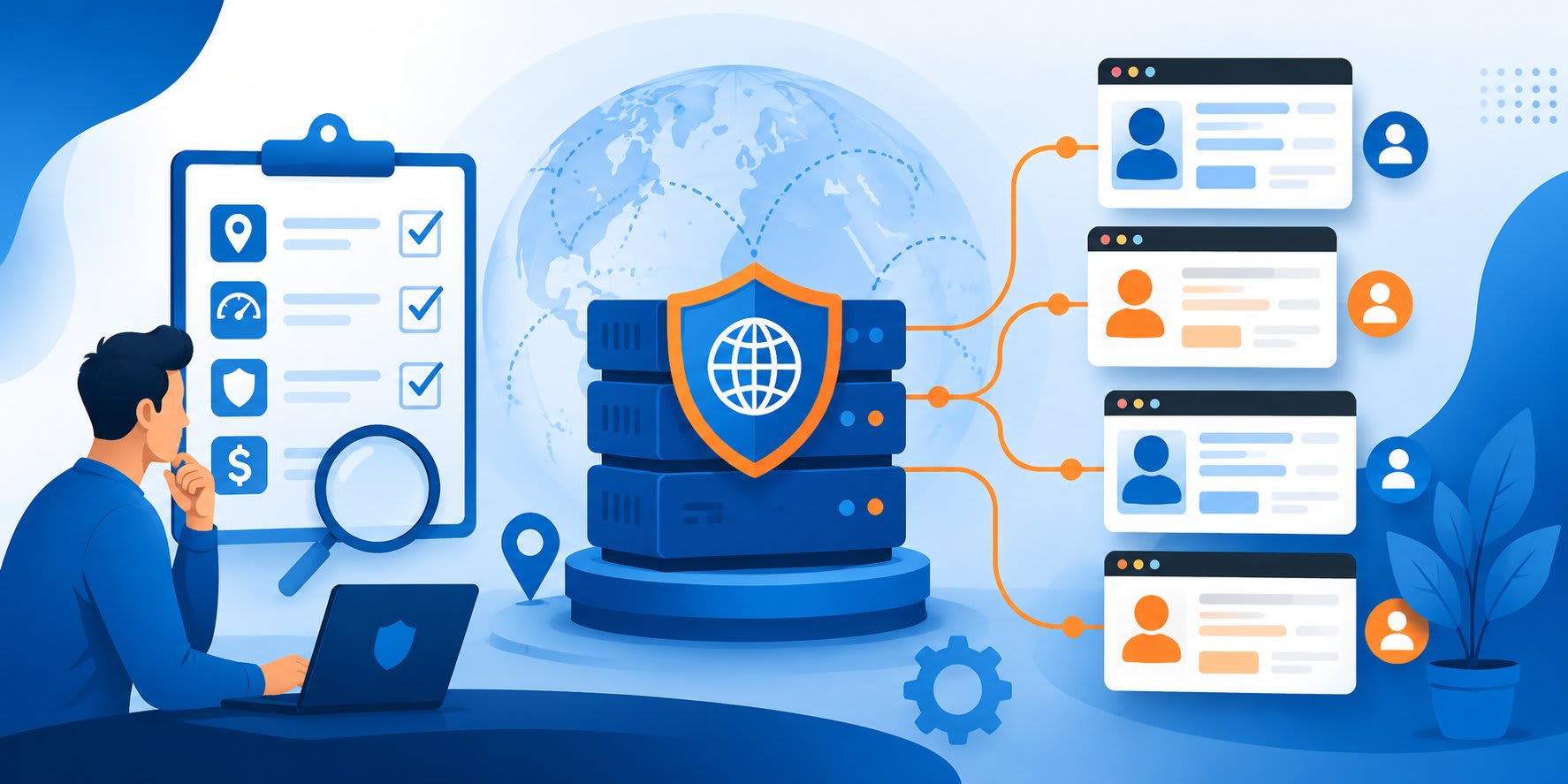
More than 70% of internet users rely on proxy servers to improve privacy and data protection. Over half of companies use them to secure corporate networks, and around 30% of users apply proxies to bypass restrictions and access limited content.
These figures raise a logical question: what exactly is a proxy?
A proxy is an intermediary server positioned between your device and the internet. It masks your real IP address, helping maintain anonymity online. Proxies are used for various purposes, including bypassing restrictions, protecting sensitive data, and in some cases improving connection performance.
What is multiaccounting?
Multiaccounting refers to creating and managing multiple accounts by one individual or a group of users.
This approach can serve different purposes depending on the context and platform.
Who needs to create multiple accounts and why?
Multiaccounting is applied in many areas. For example, in online games, users may create several accounts to gain bonuses or benefits typically offered to new players.
In social media, multiple profiles can be used to promote products or services. In some cases, users also employ multiaccounting to work around platform-imposed limits on account creation.
For businesses aiming to scale, multiaccounting becomes a practical tool. It is widely used in traffic arbitrage, cryptocurrency activities, social media marketing, betting platforms, and e-commerce.
- Traffic arbitrage: enables running more campaigns, testing different approaches, and identifying the most effective strategies.
- Cryptocurrency: helps diversify portfolios, reduce risks, and participate in exclusive opportunities such as airdrops or token sales.
- Social networks: improves reach and promotion efficiency through multiple profiles.
- Sports betting and casinos: allows placing more bets across different accounts, increasing flexibility.
- E-commerce: supports scaling by creating multiple seller profiles, expanding advertising reach, and boosting sales activity.
Which is better to choose: proxy, VPN or SSH tunnel?
All three tools can be used for multiaccounting, but they differ in functionality.
Proxy
Acts as an intermediary between your device and the internet. It hides your IP and is widely used for multiaccounting due to its simplicity and speed.
VPN (Virtual Private Network)
Creates an encrypted connection between your device and the internet. It provides a higher level of security but may reduce speed due to encryption overhead.
SSH tunnel
Establishes a secure connection via the SSH protocol. Like a VPN, it enhances security, but is typically more complex to configure and use.
Among these options, proxies are the most commonly chosen for multiaccounting because they offer a balance of speed, flexibility, and ease of integration with various platforms.
How do I choose a proxy server for multiaccounting?
When selecting a proxy, consider several key factors.
- Location of the proxy server.
- Choose IP addresses from the same region as the platform you are working with to reduce the risk of account restrictions.
- Proxy speed.
- High-speed connections are essential for efficient work with multiple accounts.
- Reliability.
- A good proxy provider ensures stable performance, strong privacy, and minimal downtime.
- Compatibility.
- Make sure the proxy supports the platforms and services you plan to use.
Using proxies for multiaccounting is a practical solution for scaling online operations and managing multiple accounts efficiently. Choosing a reliable provider ensures stable performance, high speed, and consistent results in your workflows.
Want to publish a guest post on aamconsultants.org?
Place an order for a guest post or link insertion today.